
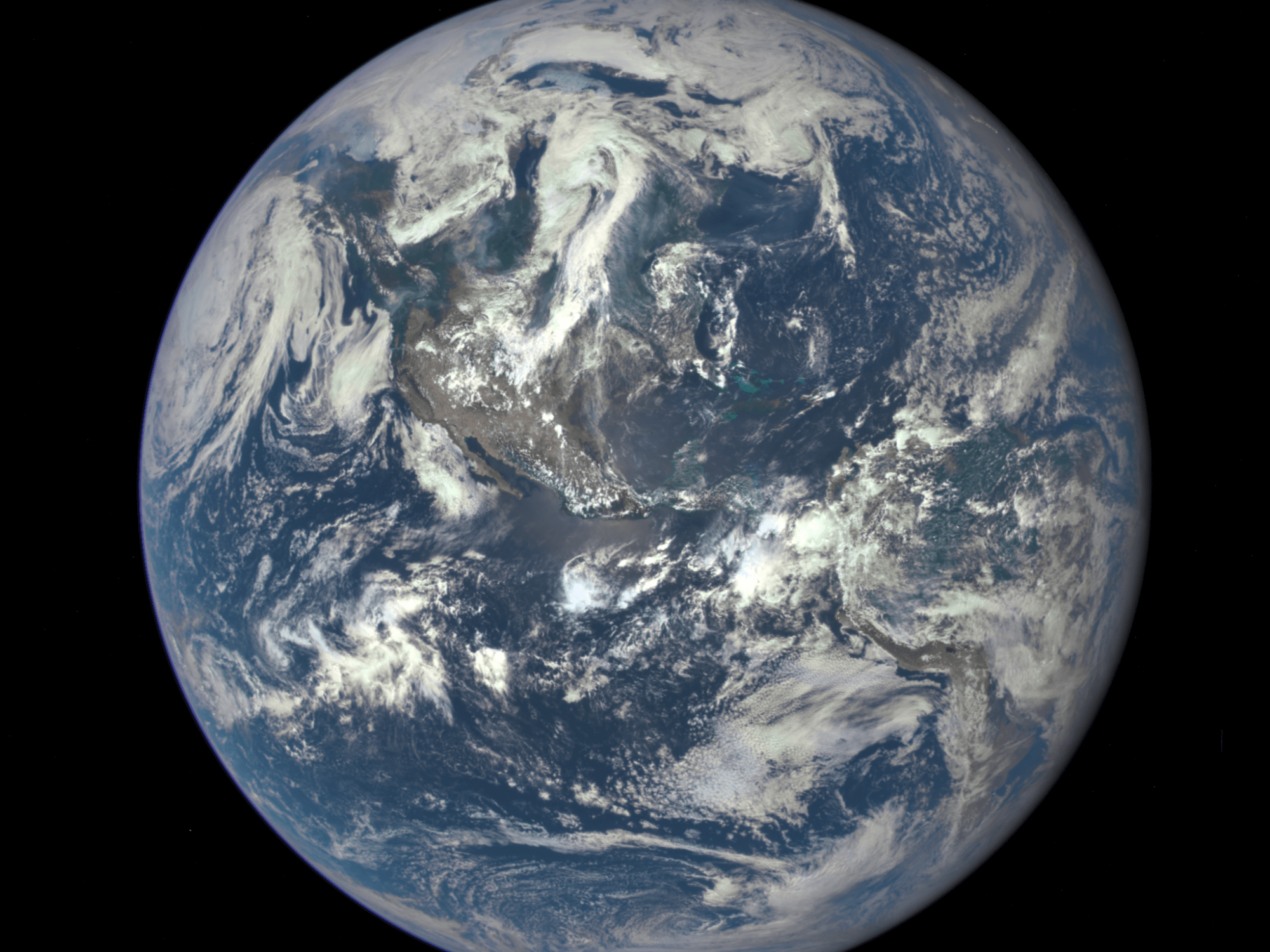
Where are the stars in NASAs new Earth photos? There’s a surprising answer: the stars don’t show up in hoots because the Earth is so bright it outshines them! I never really thought about the Suns light causing the earth to shine brightly compared to our stars but it does. Cool, huh?
NASA has a new site sharing daily EPIC photos of the moon. They are truly epic, using the Earth Poloycramaric Imaging Camera on the Deep Space Climate Observatory. Here is the link. http://epic.gsfc.nasa.gov/
Background info from NASA:
Earth Polychromatic Imaging Camera
EPIC is a four megapixel CCD camera and telescope. The color Earth images are created by combining three separate single-color images to create a photographic-quality imageequivalent to a 12-megapixel camera. The camera takes a series of 10 images using different narrowband filters — from ultraviolet to near infrared — to produce a variety of science products. The red, green and blue channel images are used to create the color images. Each image is about 3 megabytes in size.
About the Mission
The Deep Space Climate Observatory, or DSCOVR, will maintain the nation’s real-time solar wind monitoring capabilities which are critical to the accuracy and lead time of NOAA’s space weather alerts and forecasts. Without timely and accurate warnings, space weather events like the geomagnetic storms caused by changes in solar wind have the potential to disrupt nearly every major public infrastructure system, including power grids, telecommunications, aviation and GPS.
DSCOVR support solar wind alerts and warnings from the L1 orbit, the neutral gravity point between the Earth and sun approximately one million miles from Earth. L1 is a good position from which to monitor the sun, because the constant stream of particles from the sun (the solar wind) reaches L1 about an hour before reaching Earth.
From this position, DSCOVR will typically be able to provide 15 to 60 minute warning time before the surge of particles and magnetic field, known as a coronal mass ejection (or CME), associated with a geomagnetic storm reaches Earth. DSCOVR data will also be used to improve predictions of geomagnetic storm impact locations. Our national security and economic well-being, which depend on advanced technologies, are at risk without these advanced warnings.
 fullywonder.org